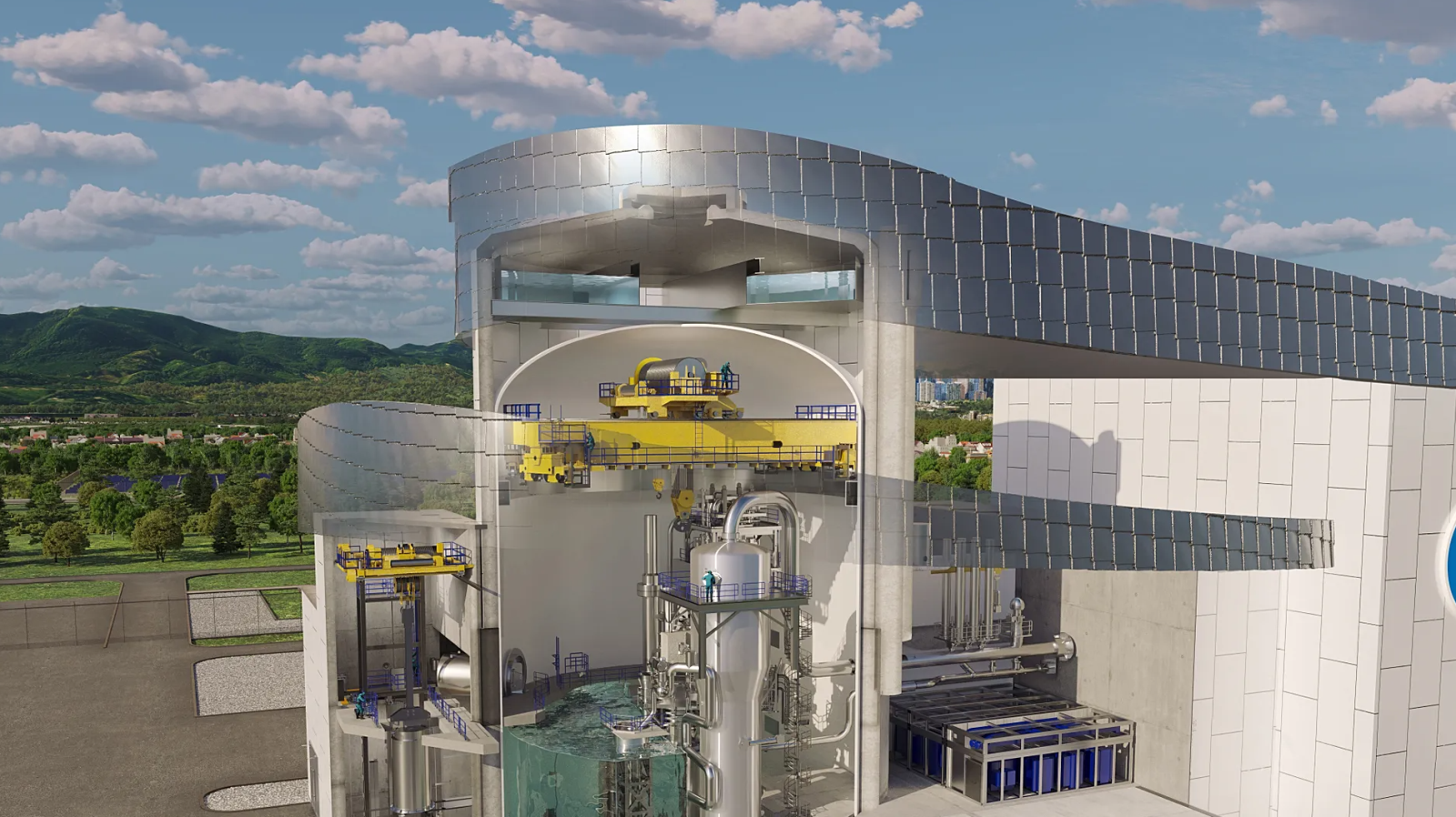
Officials in Brussels see small modular reactors (SMRs) as a potential complement to renewable energy, capable of providing stable electricity when wind and solar output falls short. The technology is being positioned not only as a climate tool, but also as a way to support heavy industry facing rising energy costs.
Under current plans, SMRs could begin to be deployed across Europe in the early 2030s, supplying both electricity and industrial heat to sectors such as steel and chemicals. The Commission argues that this could help accelerate decarbonisation while strengthening the bloc's energy security.
But the push has reopened long-standing divisions within the EU over nuclear power. Several countries, including Austria and Ireland, remain firmly opposed, while others are actively investing in what they see as a nuclear revival.
A group of eleven member states – among them France, Poland and Sweden – have already committed to closer cooperation on the development of SMRs, calling for improved regulatory frameworks and better access to financing to extend the life of existing reactors and build new capacity.
Support for nuclear energy has also been voiced at the highest political level. Commission president Ursula von der Leyen recently argued that Europe's retreat from nuclear power over recent decades has weakened its energy system, reducing access to a stable source of low-emission electricity.
A similar view has been expressed by German chancellor Friedrich Merz, who has described Germany's nuclear phase-out as a strategic misstep, even as he acknowledges that shuttered plants are unlikely to return to operation. Instead, Berlin is now exploring whether SMRs could play a role in future energy planning.
Proponents argue that SMRs differ significantly from traditional nuclear plants. Their smaller size and modular design allow components to be manufactured in factories and assembled on site, potentially lowering construction costs and reducing delays that have plagued large-scale projects.
To accelerate deployment, the Commission is preparing measures to streamline approval processes and encourage cross-border regulatory cooperation. It has also announced financial backing for emerging nuclear technologies, including a €200m guarantee scheme aimed at attracting private investment.
Climate commissioner Wopke Hoekstra and energy chief Dan Jørgensen have both linked the initiative to the broader challenge of high energy prices, arguing that expanding low-carbon supply is essential to reducing long-term costs.
Yet scepticism remains widespread. Critics question whether SMRs can be delivered at scale within the required timeframe, pointing to unresolved concerns over cost, safety and radioactive waste. Environmental groups warn that the technology risks diverting attention and funding away from renewables, which they argue are faster and cheaper to deploy.
Organisations such as the European Environmental Bureau and Climate Action Network Europe have urged policymakers to prioritise wind, solar and energy efficiency instead, warning that nuclear investments could slow the transition rather than accelerate it.
Even within policymaking circles, there is uncertainty about how quickly the strategy can be translated into concrete projects. While more than ten EU countries have expressed interest in SMRs, most initiatives remain at an early stage, with only a handful of commercial partnerships announced so far.
As Europe grapples with rising demand for electricity and the need to decarbonise its economy, the debate over nuclear power is once again moving to the centre of energy policy. Whether SMRs become a cornerstone of that transition – or remain a contested and uncertain bet – is likely to depend on how quickly the technology can prove both its economic and environmental case.