
Climate Change May Be Reducing Wind Speeds in Europe, Raising Concerns for Renewable Energy
New research suggests that global warming could be leading to calmer summer conditions across Europe, a trend that may pose challenges for the region’s growing reliance on wind energy.
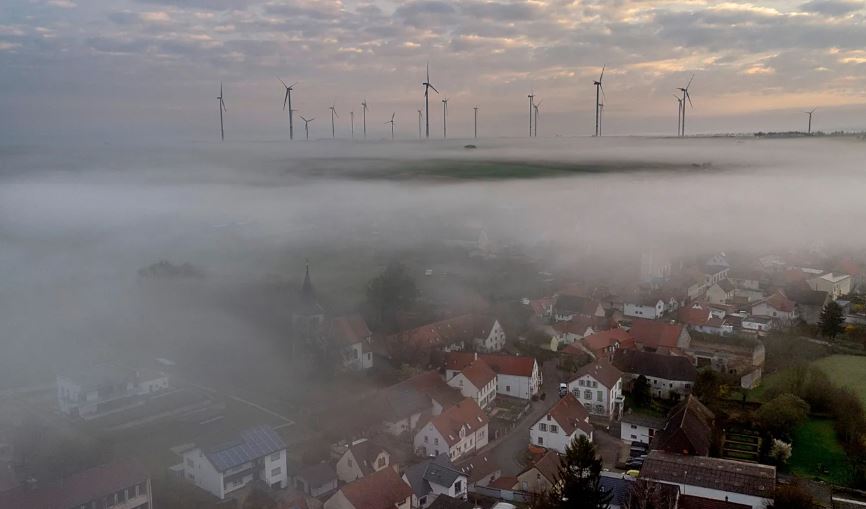
Scientists describe this phenomenon as “stilling,” a gradual decline in wind speeds linked to rising temperatures on land and in the troposphere—the lowest layer of Earth’s atmosphere. The study, conducted by researchers at the University of Illinois Urbana-Champaign and published in Environmental Research Letters, estimates that average wind speeds in Europe could fall by up to 5 percent between 2021 and 2050. Similar patterns are also expected in other northern mid-latitude regions, including parts of North America.
While the projected decrease may appear modest, researchers warn that even small changes in wind intensity could significantly affect electricity generation, particularly as Europe continues to expand its renewable energy capacity.
Challenges in Measuring Wind Trends
Understanding long-term wind patterns remains complex. Wind speeds are influenced by various local factors, such as terrain and urban structures, making accurate measurement difficult. In addition, existing datasets often fail to capture extreme variations, leaving gaps in scientific understanding.
One notable example occurred in 2021, when Europe experienced a “wind drought”—a period during which wind speeds dropped to roughly 15 percent below the annual average. The United Kingdom recorded one of its calmest periods in six decades, leading to a sharp decline in wind-generated electricity. As a result, the country was forced to temporarily restart two previously closed coal-fired power plants to meet energy demand.
Despite such events, scientists have not always agreed on how wind patterns will evolve. However, the Intergovernmental Panel on Climate Change (IPCC) has projected a long-term decline, suggesting that global average wind speeds could decrease by as much as 10 percent by the end of the century.
By prioritizing more recent data and advanced simulation models, the new study provides further evidence that summer “stilling” in Europe is becoming more pronounced. Researchers also note that the broader impact of climate change on global wind patterns is expected to become statistically significant in the latter half of the century.
Potential Implications for Renewable Energy
Although the long-term effects of declining wind speeds are still uncertain, the findings raise important questions for Europe’s energy future. Wind power accounted for 17 percent of the European Union’s electricity supply in 2024, and overall capacity continues to grow. Despite delays affecting some new projects, wind energy remains more cost-effective than fossil fuel alternatives such as natural gas.
However, experts caution that even a slight reduction in wind speeds could lead to disproportionately large fluctuations in power generation. Lead researcher Gan Zhang emphasized that energy markets are highly sensitive to small changes in supply.
“The energy system operates on marginal differences,” Zhang explained. “A shift of just 5 to 10 percent can trigger significant price changes.”
To address these risks, researchers suggest that Europe may need to diversify its renewable energy strategies and adopt more flexible solutions to maintain stability in the face of changing climate conditions.