
Climate Leaders Warn of ‘Overshoot’ Beyond 1.5°C as Risks of Irreversible Damage Grow
Global climate leaders are increasingly acknowledging that the world is likely to exceed the critical 1.5°C warming threshold set under the Paris Agreement—while emphasizing that this does not mark the end of efforts to stabilize the climate.
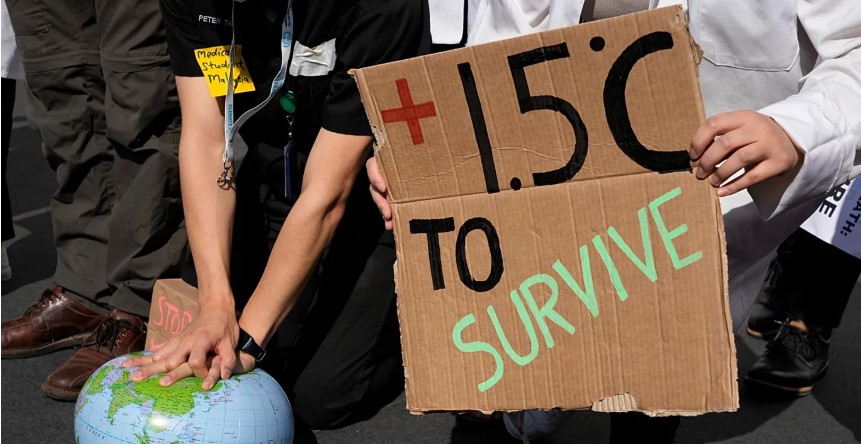
Scientists and policymakers now frequently refer to this scenario as “overshoot,” a term describing a temporary rise above the 1.5°C limit followed by a potential return to safer levels through aggressive emissions reductions and carbon removal strategies.
Crossing the Threshold Without Giving Up
The 1.5°C benchmark, established in 2015, was designed as a safeguard against the most dangerous impacts of climate change. However, recent scientific assessments suggest that surpassing this level may now be unavoidable.
Importantly, the threshold is measured as a long-term average over a decade. While global temperatures have already exceeded 1.5°C in individual years, the current long-term average remains closer to 1.3°C.
Despite this, experts warn that continued emissions place the planet on track for approximately 2.6°C of warming by the end of the century—well beyond safe limits.
Why 1.5°C Still Matters
Scientists stress that 1.5°C should not be viewed as a flexible target but as a critical boundary. Exceeding it significantly increases the risk of triggering irreversible changes in Earth’s systems.
Potential consequences include the widespread loss of coral reefs, intensifying and more frequent extreme heat events, and the crossing of tipping points such as the collapse of major ice sheets or disruption of key ocean circulation systems.
These tipping points could fundamentally alter global climate patterns, making future warming more difficult—or even impossible—to reverse.
A Shift in Climate Strategy
In recent discussions, international leaders have begun to shift their messaging. Rather than focusing solely on avoiding 1.5°C altogether, there is growing emphasis on limiting how far and how long temperatures exceed this threshold.
UN climate officials maintain that returning below 1.5°C remains both necessary and achievable, even after a temporary overshoot. This approach reflects a more pragmatic response to current emission trends while preserving long-term climate goals.
The Role of Carbon Removal
Central to the overshoot strategy is the expectation that carbon dioxide levels can eventually be reduced. Natural systems such as forests and oceans already absorb some emissions, and emerging technologies aim to remove carbon directly from the atmosphere.
However, experts caution that large-scale carbon removal technologies are not yet developed or deployed at the level required to significantly impact global temperatures.
Without these tools, managing an overshoot scenario would be extremely difficult, if not impossible.
A Narrowing Window of Opportunity
Recent projections suggest that even under ambitious emission reduction scenarios, global temperatures could exceed 1.5°C around 2030, peak near 1.7°C, and only return below the threshold decades later.
At current emission levels, however, the world is not heading toward a temporary overshoot but rather a prolonged and worsening temperature increase extending well beyond 2100.
A Decade of Missed Chances
Climate scientists point out that a decade ago, avoiding 1.5°C without overshoot was still considered achievable through coordinated global action. Today, that pathway has largely closed.
The concept of overshoot, therefore, represents not a preferred strategy but a fallback—one that reflects both the urgency of the situation and the consequences of delayed action.