
Floods Cause 19% Drop in Farming Income in England for 2023
Low Yields and Crop Prices Contribute to a 13% Decline in Farm Output
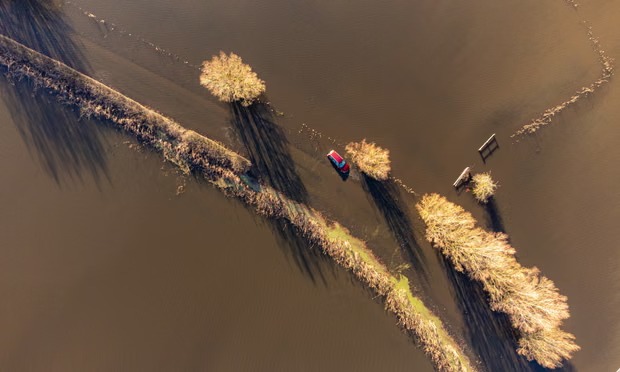
In 2023, farming income in England experienced a significant 19% decline, primarily due to floods that made harvesting many crops impossible. This decline has led farmers to call for increased government support as climate change results in more frequent and severe weather disruptions, such as droughts and floods.
Farming's contribution to England's economy also decreased in 2023, dropping by £1 billion to £10 billion, an 8.7% fall compared to 2022. Total income from agriculture was £4.5 billion, down by £1.1 billion or 19% from the previous year. The decrease in total income was largely driven by a substantial reduction in crop outputs, according to the Department for Environment, Food and Rural Affairs (Defra).
Farm output, which includes crops sold from farms, fell to £9.9 billion, a decrease of £1.5 billion or 13.1% compared to 2022. This was due to a combination of low crop prices, such as for wheat, and poor yields. The Met Office reported 1,695.9mm of rainfall in England from October 2022 to March 2024, the highest for any 18-month period since comparable data collection began in 1836. Scientists attribute this to climate change, which is expected to cause more intense rainfall in the UK.
Martin Lines, CEO of the Nature Friendly Farming Network and an arable farmer, stated: “Farm income has significantly decreased due to the impacts of climate change on weather and market price fluctuations. Farmers find themselves at a disadvantage due to market forces, even though there’s plenty of money in the system. The income that farmers receive from food production has declined, while food retailers continue to make record profits. Without adapting to a changing climate, the future of UK farmers, businesses, and food security could be at risk.”
Farmers are also facing changes in government support. The EU-derived basic payments scheme is being phased out, requiring English farms to sign up for environmental schemes to receive funding. The basic payments previously provided financial stability during bad weather and low commodity prices. However, the new Labour government has not yet committed to maintaining the £2.4 billion annual budget for environmental land management schemes established by the previous administration.
Joe Evans, vice-president of the Country Land and Business Association, commented: “Farmers’ incomes are continuing to fall after decades of economic neglect. Labour has put economic growth at the heart of its agenda, and the countryside will be key to delivering this. We’ve issued Labour with a programme for government to deliver a new era of industry cooperation. This includes committing to an annual £4 billion agricultural budget, reforming planning laws to help farmers diversify income, and proposals for ministerial-led, cross-departmental working groups to identify and remove barriers to growth. The rural economy is 19% less productive than the national average, closing this gap is key to our future prosperity. It’s time we had a government that matches the ambition of the countryside.”
A Defra spokesperson affirmed the new government’s commitment to protecting farms and rural communities from flooding dangers. “That is why we will launch a flood resilience taskforce to turbocharge the delivery of flood defences, drainage systems, and natural flood management schemes across the country. We will go further to boost Britain’s food security, protecting farmers from being undercut in trade deals, cut energy bills by switching on GB Energy, and use the government’s purchasing power to back British produce.”
Dördüncü Haber Yapay Zeka:
Wind Power Overtakes Coal in the U.S. During March and April
Despite Challenges, Offshore Wind Shows Resilience and Growth Potential
In a significant milestone for renewable energy, wind power generated more electricity than coal in the U.S. during March and April of this year. This development signals that despite the setbacks faced by the offshore wind industry last year, the sector continues to make substantial progress.
The U.S. Energy Information Administration (EIA) has indicated that while these figures may fluctuate, the overall trend shows a steady decline in coal-generated energy since 2008, accompanied by a consistent rise in wind power. The proliferation of large turbines harnessing wind energy has become more common across the U.S., both onshore and offshore. However, the offshore wind sector has encountered several challenges, including economic pressures, lengthy approval processes, and misinformation campaigns. These hurdles have led to at least six companies canceling or renegotiating contracts for new projects.
Barbara Kates-Garnick, a professor at Tufts University's Fletcher School who specializes in clean energy technology and policy, commented on the situation: "Even with the hiccups, there should be forward movement in offshore wind, even in a Trump administration."
As of now, the U.S. boasts over 74,500 wind turbines, with around 3,000 new turbines being constructed annually since 2005. While wind power accounted for 10.2% of the U.S. energy production in 2023, it still lags behind natural gas (43.1%) and nuclear energy (18.6%). However, wind power represents nearly half of all renewable energy production in the country.
Efforts to expand wind power are a crucial part of the broader strategy to reduce dependence on fossil fuels. Offshore wind projects, in particular, are seen as vital due to their potential to generate more energy compared to onshore projects. Offshore installations are typically larger, and ocean winds are generally stronger.
Nevertheless, the offshore wind sector has faced significant obstacles. Global economic challenges, such as rising inflation and supply chain disruptions post-pandemic, have hampered development efforts. For instance, Avangrid, which operates the largest offshore wind farm in the U.S., canceled two projects in Connecticut and Massachusetts last year due to high development costs. Similarly, Ørsted, a Danish renewable energy company, renegotiated a contract for a New York wind project and canceled two projects in New Jersey due to economic pressures.
Despite these setbacks, Ørsted’s Maddy Urbish remains optimistic: "While we have definitely seen challenges, we've also seen real resilience." She expects the industry to expand with growing bipartisan support for renewable energy and increasing electricity demand, which the EIA predicts will be 2% higher in the second half of 2024 compared to the same period in 2023