
Swiss Glacier Collapse Underscores Rising Global Risks as Ice Loss Accelerates
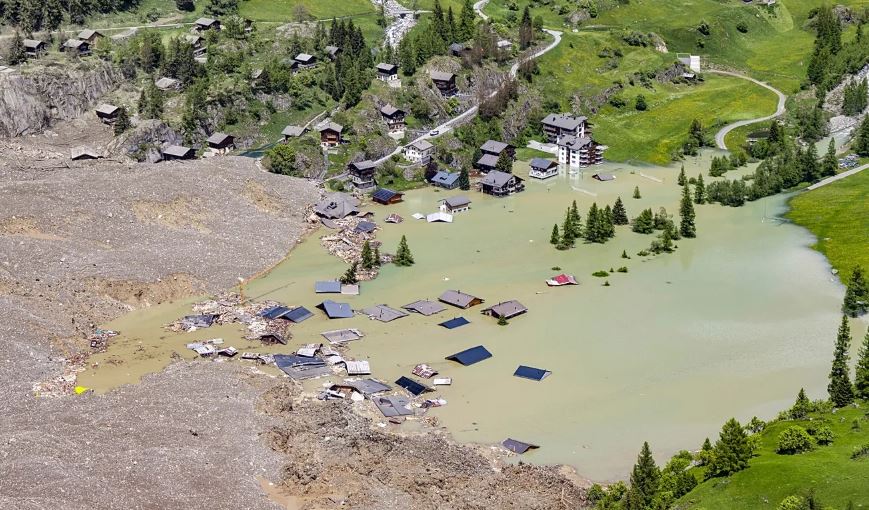
The recent landslide that buried much of a village in Switzerland has drawn renewed attention to the growing dangers linked to glacier instability, as scientists warn that climate change is accelerating ice melt worldwide.
Experts say that while the mechanisms behind glacier collapses vary across regions—from the Alps and Andes to the Himalayas and Antarctica—human-driven climate change is a common underlying factor in nearly all cases.
In the Swiss Alps, the incident occurred near the village of Blatten in the Lötschental valley, where part of a mountainside gave way. According to glacier researcher Martin Truffer from the University of Alaska Fairbanks, the collapse was triggered by the thawing of mountain permafrost, which destabilized the rock face above the Birch Glacier. Over recent years, falling debris accumulated on the glacier’s surface.
Although this debris initially acted as insulation and slowed melting, its increasing weight caused the glacier to shift. This movement intensified sharply in the weeks leading up to the collapse. Authorities had already evacuated around 300 residents and their livestock after recognizing the imminent risk of a large-scale landslide.
Glacial Lakes Add to the Threat
Beyond collapses, scientists are also concerned about glacial lakes, which form as ice melts and retreats. These lakes can suddenly burst, releasing massive volumes of water with devastating consequences.
In some cases, water pressure can even lift a glacier, allowing it to drain rapidly. Truffer pointed to recurring flooding in Juneau, Alaska, where a lake forms annually due to a retreating glacier and eventually overflows.
Similar incidents have occurred globally. In 2022, a massive section of the Marmolada glacier in Italy broke off during a heatwave, triggering a deadly avalanche that killed 11 people. In Tibet, two glacier collapses in 2016 claimed lives and livestock. Peru has also experienced multiple glacier-related disasters, including a 2006 event that generated a small tsunami and a more recent landslide caused by an overflowing glacial lagoon.
Lonnie Thompson, a glacier specialist at Ohio State University, emphasized the unpredictability of such events. “Glaciers can fail very quickly,” he said, warning that their increasing instability poses a serious and growing risk to communities worldwide.
Long-Term Consequences Already Locked In
Scientists stress that greenhouse gas emissions from fossil fuels have already committed the planet to significant glacier loss, regardless of future action. Many glaciers have been retreating for decades, and the pace of melting continues to accelerate.
In the Alps, glacier area has declined by about 50 percent since 1950, with projections suggesting that most could disappear entirely by the end of this century. Switzerland alone lost 4 percent of its glacier volume in 2023, following an even steeper 6 percent decline the year before.
Elsewhere, Peru has lost more than half of its glacier coverage over the past 60 years, with dozens of glaciers vanishing in recent years due to rising global temperatures.
A recent study published in Science indicates that even if global temperatures were to stabilize at current levels, approximately 40 percent of the world’s glaciers would still be lost. However, limiting warming to 1.5°C—an objective set under the 2015 Paris Agreement—could preserve significantly more ice, potentially doubling the amount saved compared to higher warming scenarios.
Despite this, researchers warn that some regions are already beyond recovery. In certain parts of Alaska, glaciers are expected to disappear regardless of future temperature changes, simply because the current climate conditions are already too warm to sustain them.
“The reality is that some glaciers are already doomed,” Truffer said, noting that their continued existence in some places is only temporary due to the time it takes for ice to fully melt.